Chafer grub( Schyzonycha spp.) (c) A. M. Varela, icipe
Termites
Termites(Coptotermes formosanus) (c) A. M. Varela, icipe
Millipedes
Millipedes are brown to blackish in colour and curl-up when disturbed. (c) Courtesy EcoPort (http://www.ecoport.org) : Agricultural Research Council of South Africa
Aphids
Groundnut aphid colony on cowpea. Apterae are 1.4-2.2 mm long. Alatae (winged form) 1.4-2.1 mm. (c) James Litsinger. Reproduced from the Crop Protection Compendium, 2004 Edition. (c) CAB International, Wallingford, UK, 2004
Groundnut Hopper
Groundnut hopper Hilda patruelis. Size is about 5 mm in length (c) ICRISAT
Thrips
Thrips damage on groundnut (c) Steve L. Brown, University of Georgia, Bugwood.org
Groundnut Leafminer
Damage caused by Groundnut leafminer (Aproaerema modicella). Leaflets became deep brown, rolled, and dried up prematurely due to enlarged leaf mines (c) ICRISAT
Storage Pests: Moths and Beetles
Dried currant moth (Cadra cautella) – The larvae range from 1.5 mm to 1.5 cm (15 mm) in length and are light brown in colour with dark brown spots on the skin (cuticle). (c) Clemson University – USDA Cooperative Extension Slide Series, Bugwood.org
Root-knot Nematodes
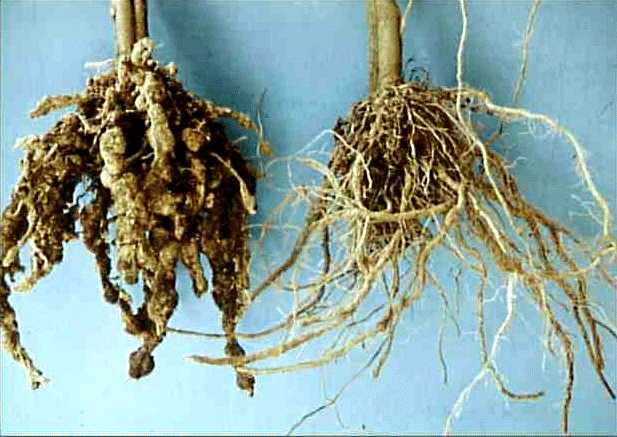
Root-knot nematodes(Meloidogyne incognita / M. javanica) Roots of severely attacked (left) and healthy plant (right). Affected plants are normally stunted and eventually wilt and die. The most characteristic symptom is formation of root galls (knots) and these can be seen with the naked eye. Affected roots rot. (c) A. M. Varela, icipe
Spider Mites
A related Spider mites species on cotton leaf. They are very tiny (they rarely exceed a size of 0.5 mm) (c) O.P. Sharma, NCIPM, New Delhi. India, Bugwood.org