Credit: Biovision-Infonet
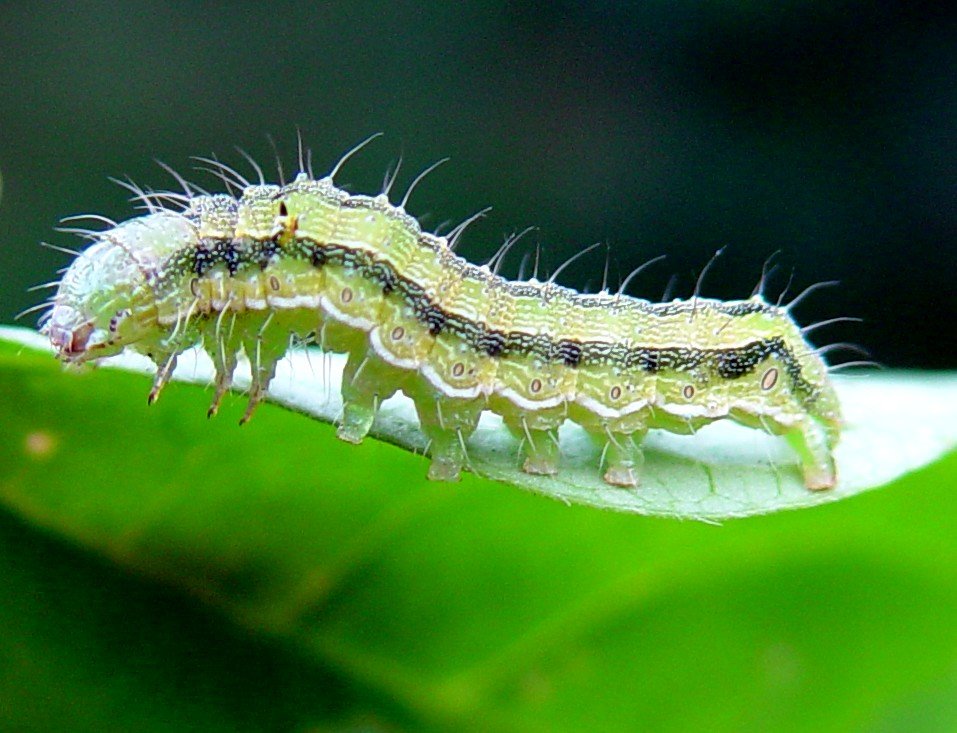
(c) A.M. Varela, icipe
Several caterpillars are important pests as pod borers in common beans and French beans. The most common are the African bollworm (Helicoverpa armigera) and the legume pod borer (Maruca testulalis). They feed on leaves, flowers, pods and seeds. The African bollworm caterpillars are 3 to 4 cm long. They make clean circular holes in the pods. One caterpillar may damage several pods. Caterpillars of the legume pod borer attack pods at the point of contact with other pods, leaves or the stem. They frequently web together flowers, pods and leaves with excrements.
Pod borers usually do not cause significant yield reduction in beans. However, they are quarantine pests, and are particularly important in French beans grown for export. If only 1 caterpillar is found in a consignment sent to Europe, the whole consignment may be rejected. If pod borers are found in a field, the beans harvested should be sorted very thoroughly to remove the bollworms manually.What to do:
- Monitor the crop regularly
- Handpick and destroy infested pods and pod borers. This helps when their numbers are low and in small fields.
- Spray crop with biological pesticides (e.g. Bt products or neem).
- If pod borers are found in a French beans field, sort harvested pods very thoroughly and remove pod borers manually.
Maize Pest
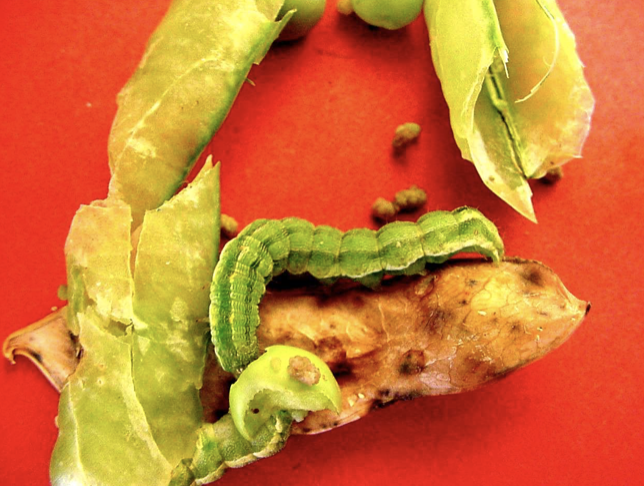
(c) A.M. Varela, icipe
African bollworm (Helicoverpa armigera)
Caterpillars of the African bollworm also known as the corn worm or earworm attack mainly the developing cobs, although they may occasionally feed in the leaf whorl or on tender tassels. Eggs are laid on the silks. Caterpillars invade the cobs and feed on developing grain. Development of secondary infections is common. Local outbreaks of this pest are sometimes severe.
What to do:
- Conserve natural enemies. Parasitic wasps, ants and predatory bugs are important in natural control of the African bollworm.
- Monitor the crop regularly.
- Use bio-pesticides. Plant extracts (e.g. neem, garlic, chilli,) and Bt are reportedly effective against the African bollworms. However, timing of application is very important. Spraying when caterpillars are inside the cob would be ineffective. For more information on Neem click here.For information on Bt click here
- Handpick and destroy pod borers. This helps when their numbers are low and in small fields.