Maize Lethal Necrosis (MLN)

Credits: Biovision-Infonet


(c) Cimmyt

A serious new disease of maize appeared in the farmers’ fields in eastern Africa in 2011. Called maize lethal necrosis (MLN; or corn lethal necrosis, CLN), it can devastate maize crops. Infection rates and damage can be very high, seriously affecting yields and sometimes causing complete loss of the crop.

The disease is difficult to control for two reasons:

1.It is caused by a combination of two viruses that are difficult to differentiate individually based on visual symptoms.

2.The insects that transmit the disease-causing viruses may be carried by wind over long distances.

MLND is mainly spread by a vector, transmitting the disease from plant to plant and field to field. The most common vectors are maize thrips, rootworms, leaf beetles and aphids. Hot spots appear to be places where maize is being grown continuously.

In Africa, the disease was first reported in Kenya, (South Rift Valley – Bomet and Naivasha districts) in September 2011 although its extent at that point suggested that the disease has been present for some time. According to the Kenyan Ministry of Agriculture, two percent of the maize harvest was affected in 2012. MLND has also spread rapidly into Tanzania, Uganda and South Sudan in the meantime.

National and global research and extension organizations, laboratories, and seed companies are working together to control the spread of the disease and to develop and deploy disease-resistant maize varieties for the farmers as soon as possible.

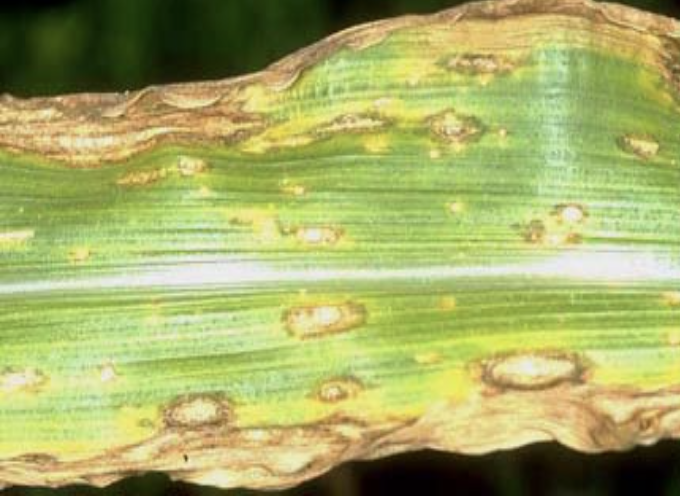
Currently, all maize varieties at every stage appear to be susceptible to the disease. The symptoms include: – Mild to severe mottling on the leaves, usually starting from the base of young leaves in the whorl and extending upwards toward the leaf tips. – Stunting and premature aging of the plants. – Dying (known as ‘necrosis’) of the leaf margins that progresses to the mid-rib and eventually the entire leaf. – Necrosisof young leaves in the whorl before expansion, leading to a symptom known as ‘dead heart’ and eventually plant death

What to do:

Prevention:

  • MLN does not occur on crops other than maize; so avoid growing maize after maize. Diversify your farm enterprise by planting different crops each season.
  • Do not plant a new maize crop near an infected field. Wind-blown insect vectors can transmit the disease from the infected field to the new crop
  • Plant maize at the onset of the main rainy season, rather than during the short rain season; this creates a break between maize crops and interrupts the disease cycle
  • Weed fields regularly to eliminate alternate hosts for insect vectors. Use maize varieties that are resistant to MLN

Control:

  • Immediately remove diseased plants from your fields. You can feed the leaves to livestock
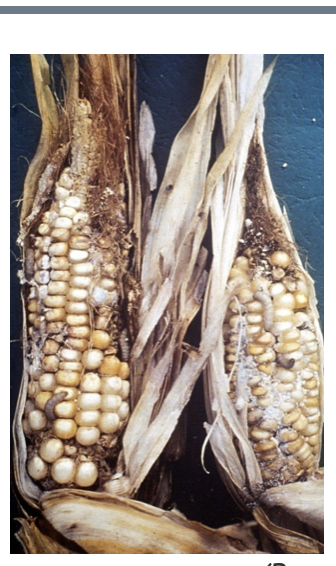
  • Do not allow humans or animals to eat infected ears or grains, which may contain secondary fungal infections and harmful mycotoxins. Burn infected ears and grains.

Ear rots

Gibberella zeae / G. fujikuroi)

Credits: Biovision-Infonet

Gibberella ear rot (Gibberella zeae) on maize
(c) Scot Nelson, 2008

Characteristic symptoms include pink to brick-red colour on ears, husks and kernels. The fungi often gain entrance to the ears through channels made by earworms and borers. Bird damage to the ears also facilitates disease infection.

Symptoms 

Roots: dry rot.

Seedlings: blight and subsequent death of the seedling.

Leaves: leaves become a dull green colour when rots and stalks are infected early.

Stalks: lesions are a dark brown to black colour in which black perithecia may be produced near the lower nodes. The pith is shredded and is pink to red in colouration.

Ears: the fungus infects the ear via the silk channel and causes a red rot of the kernels from the tip of the ear. This may spread over the whole ear.

What to do:

  • Use resistant varieties if available
  • Manage pests attacking the ears.

Head smut

(Sphacelotheca reiliana)

Credits: Biovision-Infonet

Partial infection by head smut fungus (Sphacelotheca reiliana)of the tassel of maize
(c) Courtesy EcoPort: David C. Nowell

The first symptoms become evident when tassels and cobs (ears) appear. These parts may be completely or partly converted into smut galls. Smut galls are initially covered by a delicate membrane that breaks open and exposes a mass of reddish-brown to black spores and strands of vascular tissue. The strands or fibres in the galls distinguish this disease from common smut. Head smut is seed-borne.

What to do:

  • Use resistant varieties, if available.
  • Practise crop rotation.
  • Eliminate volunteer host plants.

Common maize smut

(Ustilago maydis)

Credits: Biovision-Infonet

Blister-like galls of common maize smut (Ustilago maydis), up to 15 mm diam., on a maizecob before they have ruptured to release spores.
(c) Courtesy EcoPort: Grahame Jackson

Characteristic symptom of common smut is formation of galls or tumuors on above-ground parts of maize plant. Galls frequently are from one to several centimetres in diameter. The galls are at first covered by a shining, whitish-green membrane. As the gall enlarges, the membrane ruptures, exposing a powdery black mass of spores.

What to do:

  • Use resistant varieties if available.
  • Practise crop rotation.
  • Practise field sanitation. In smallholdings remove and destroy smut galls before smut spores are produced. This may help reduce prevalence of the disease in following years.

Southern leaf blight

Bipolaris maydis (Helminthosporium maydis / Cochliobolus heterostrophus)

Credits:Biovision-Infonet

Southern leaf blight(Cochliobolus heterostrophuson) on maize
(c) Courtesy EcoPort: LandCare Ltd., New Zealand

Symptoms first appear as small yellow dots that become elongated between veins. They later become brownish to creamy white in colour with reddish to purplish brown borders. Light brown leaf spots with a brown margin, at first elliptical, becoming rectangular, up to 25 mm long and 2 – 6 mm wide. The spots are at first restricted by the leaf veins, but later they may merge. Leaves dry out and die prematurely.

Silks, portions of the husks and cobs may turn black. A black mould may develop on cobs. Disease development is promoted by prolonged wetness on foliage, extended dew, RH (97-100%) and relatively warm temperatures (24-35degC).

Spread is by airborne spores; and the fungus is also seed-borne. Survival in soil occurs for up to 12 months.What to do:

  • Use disease-free seed or treated seed (steam-air mixture at 53.9 – 55 degC for 17 minutes)
  • Practise field sanitation, destroy crop residues and volunteer plants
  • Practise crop rotation
  • Use tolerant, resistant varieties if available

Northern leaf blight

Exserohilum turcicum (Helminthosporium turcicum / Dreschslera turcica / Trichometasphaeria turcica / Setosphaeria turcica)

Credits: Biovision-Infonet

Early development of light brown, elliptical lesions of Northern corn leaf blight (Setosphaeria turcica) on maize leaves.
(c) Courtesy EcoPort: David C. Nowell

Small oval (egg-shaped) spots first appear as water-soaked areas. They are dark and greyish-green in colour, turning greenish tan. With age they get bigger and become cigar-shaped. After rains or heavy dews, spores develop abundantly on both surfaces of the spots, particularly at the centres, giving a dark-green, velvety look to the spots. The spots may join and form large areas, which may kill entire leaves. Heavily infected leaves appear dry as if affected by drought. The disease is favoured by heavy and frequent rains, high relative humidity (above 90%) and relatively low temperatures (20-25°C). Warm dry conditions check disease development.What to do:

  • Use of tolerant, resistant varieties if available
  • Practise good field sanitation. Remove or plough in crop residues after harvest.
  • Practise crop rotation.

Maize streak virus

Credits:Biovision-Infonet

Maize leaf streak virus
(c) A. A. Seif, icipe

The virus causes a white to yellowish streaking on the leaves. The streaks are very narrow, more or less broken and run parallel along the leaves.

The virus is transmitted by leafhoppers (Cicadulina mbila and C. bipunctella zeae). Maize streak virus is a serious constraint to maize production in sub-Saharan Africa. The reduction in yields depends on the time of infection. Plants infected at early stage usually do not produce any cobs. Yield losses in East Africa vary between 33 and 55% under natural infection conditions. In Nigeria, 75-100% of maize plants can be infected at the end of the growing season. However, resistant varieties in these areas appear to withstand these epidemics (Anon., 1983). Sugarcane, sorghum, millet, wheat, barley, oats, rye and wild grasses can also be severely affected.

What to do:

  • Use of tolerant, resistant varieties if available.
  • Plant early in the season.
  • Eradicate grass weeds.
  • Control vectors.

Maize plant hopper (corn lantern fly)

(Peregrinus maidis)

Credits: Biovision-Infonet

Maize plant hopper (Peregrinus maidis)
(c) Courtesy EcoPort:Jannette Mitchel, ARC Pretoria

It is 4-5 m long and greyish in colour. The transparent wings are about twice as long as the body and show marked dark-brown veins. It is commonly found in groups in the funnel of the plants, the whorl, leaf sheath or underside of leaves. This insect produces large quantities of honeydew. As a result, sooty mould is often evident near the sites of aggregation. Nymphs and adults are in close association with ants, which feed on the honeydew produced by this plant hopper.

This plant hopper transmits the maize mosaic nucleorhabdovirus (MMV), maize stripe tenuivirus (MSpV), and maize line virus that can become a limiting factor in maize production.

What to do:

  • Practise crop rotation (alternate maize with cotton, root crops, and other non-graminae crops) to break the lifecycle of plant hoppers.
  • Plough under or burn stubbles and plant debris right after harvest to kill remaining eggs, nymphs and adults.
  • Avoid excessive N-fertiliser applications (N makes plant susceptible and attractive to maize plant hoppers).
  • Keep planting distance wide enough for sunlight to penetrate (shady areas favour the maize plant leafhopper.
  • Conserve natural enemies. Important plant hopper natural enemies are parasitic wasps (they parasitise eggs and nymphs), mirid bug (prey on eggs), dragonflies and damselflies (prey on moving adults), spiders and earwigs (prey on nymphs and adults). Intercropping with legumes is recommended as harbourage of natural enemies, as soil conditioners, and for added income.

Stemborers: African Maize Stalkborer

Credits: Biovision-Infonet

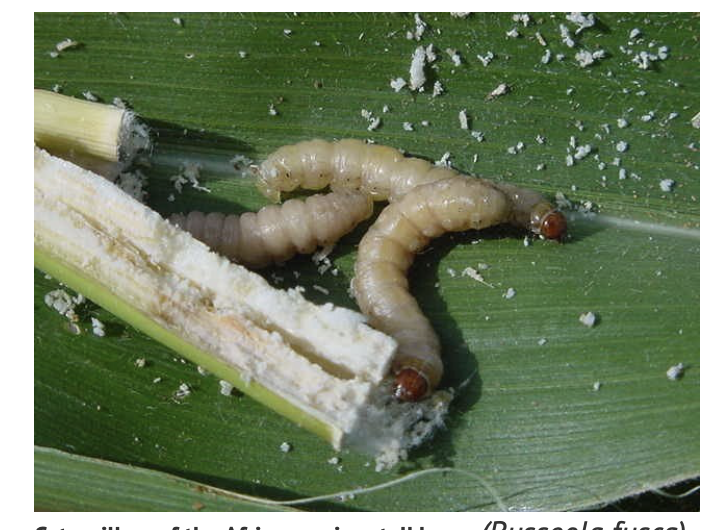
Caterpillars of the African maize stalkborer (Busseola fusca).
(c) D. Cugala, Stemborer team, icipe
African maize stalkborer(Busseola fusca) damage on maize. Caterpillars are relatively featureless and noctuid, growing to a length of up to 4 cm. They lack conspicuous hairs or markings and look smooth and shiny. Colour is variable but usually creamy-white
(c) A. M. Varela, icipe

Stemborers are the most important insect pests of maize in sub-Saharan Africa. Yield losses vary between 10-70%. Several species have been reported. The importance of a species varies between regions, within a country or even the same eco-region of neighbouring countries. At least four species attack maize in eastern and southern Africa, with yield losses reported to vary from 20 to 40%, depending on agroecological conditions, crop cultivars, agronomic practices and intensity of infestation.

The most important are the African maize stalkborer(Busseola fusca) and the spotted stemborer (Chilo partellus).

The pink stalkborer (Sesamia calamistis) and the sugarcane stalkborer (Eldana saccharina) are of minor importance in maize.

Early warning signs: Young plants have pinholes in straight lines across the newest leaves. This is the time to treat – before the caterpillars move into the stem.

What to do:

  • Conserve natural enemies. Parasitic wasps and predatory ants are important in natural control of stemborers.
  • Destroy crop residues to kill pupae left in old stems and stubble and prevent carry-over populations. This helps in limiting initial establishment of stemborers on the following season’s crops.
  • Intercrop maize with crops that are non-hosts for stemborers (e.g. cassava and grain legumes).
  • Intercrop maize with a repellent plant such as desmodium and plant an attractive trap plant, such as Napier grass, as a border croparound this intercrop to protect maize from stemborers. This technology is known as “push-pull”.
  • Use neem products. Simple neem products are reported to be effective for control of stemborers. Place a small amount of neem powder (ground neem seeds) mixed with dry clay or sawdust at a rate of 1:1 in the funnel of the plant. One kg powder should be sufficient to treat 1500 to 2000 plants. Rainwater dissolves the active substances in neem powder as it gathers in the funnel and washes out the powder. Where rainfall is irregular a liquid neem seed extract can be sprayed into the funnel.

White Grubs

Credits: Biovision-Infonet

White grub on French bean plant
(c) A.M. Varela, icipe

White grubs are the larvae of scarab “chafer” beetles. They are white, C-shaped with a brown head and 3 pair of legs. Some species of whitegrubs (e.g. Phyllophaga spp, Heteronychus spp.) feed on roots of maize plants. Root damage is manifested by wilting seedlings, poor stands, and patches of tilted or lodged plants showing uneven growth. Injured plants can easily be pulled out of the ground.

Feeding of adults on maize leaves is usually not of economic importance. However, adults of the black maize beetles (Heteronychus spp.) are reported as major pests of cereals in many parts of Africa. They eat the stems of young shoots just below the ground. One adult beetle may destroy several seedlings in a row.

What to do:

  • Remove old plants and weeds before planting.
  • Plough and harrow the field to expose eggs and grubs to predators (e.g. ants and birds) and to desiccation by the sun. Once exposed, they can also be picked by hand. This is feasible in small plots.
  • Provide conditions for growing healthy plants. They can tolerate grub feeding without serious damage.
  • Ensure proper drainage. Grubs love moist soil, especially with decaying organic matter. Female beetles prefer to lay eggs on moist-decaying organic matter.
  • Avoid planting maize immediately after old pasture in areas where grubs are frequently seen.
  • Practise crop rotation. In particular, in fields where whitegrubs are common.
  • Use trap crops and / or repellent plants. Good trap crops are African marigold, sunflower, and castor. Repellents plants are chives, garlic, tansy, and catnip. The crops trap and repel adult beetles from attacking the main crop grown (Golden Harvest Organics, 2003).