Downy Mildew

Credits:Biovision-Infonet
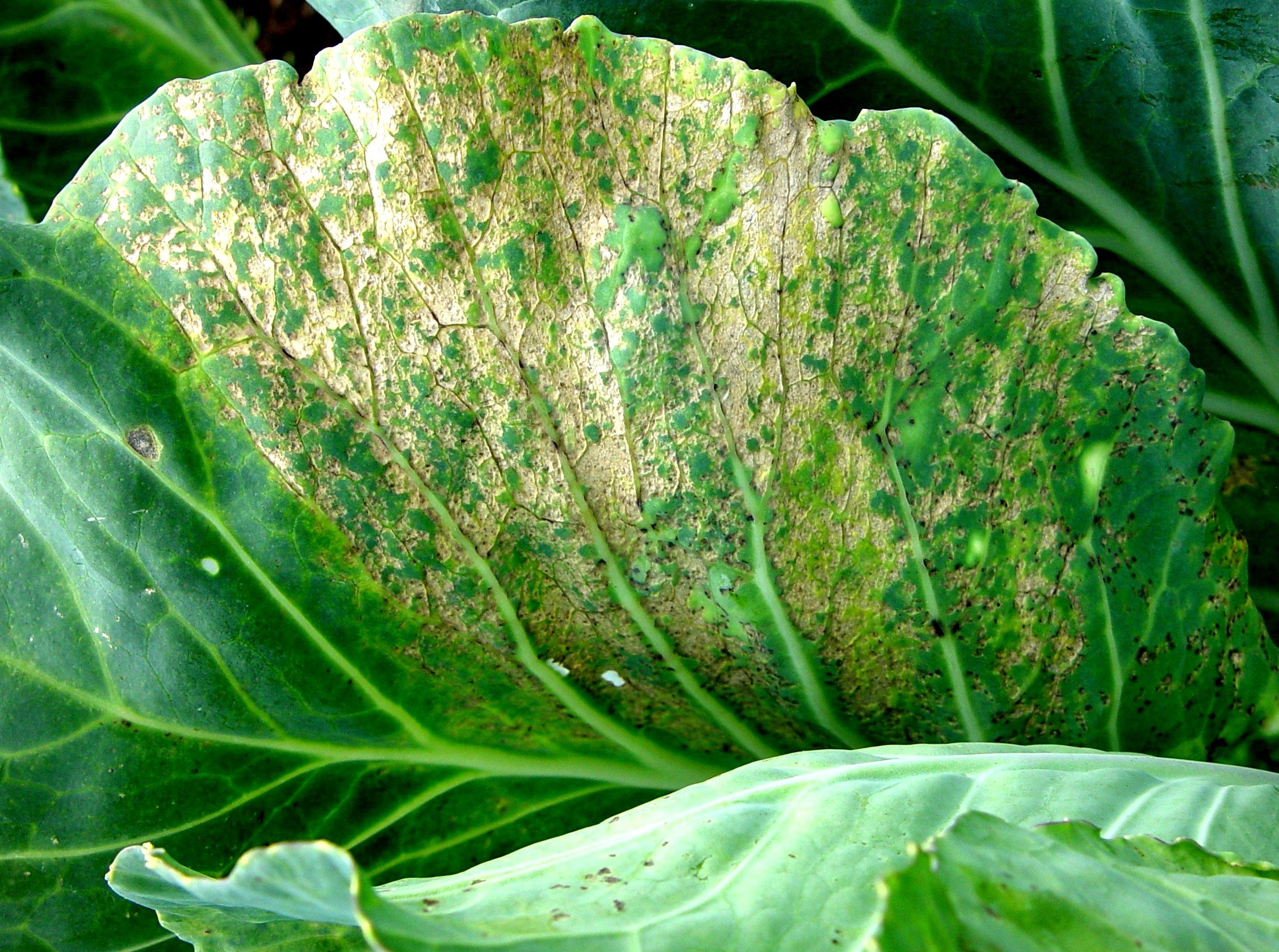
Downy mildew on cabbage
(c) A.M. Varela, icipe

Symptoms on leaves appear as small, pale-yellow areas on upper leaf surface. Under humid conditions, a purplish, grey whitish growth may be seen on the underside of the yellowish spots. Affected leaves curl, shrivel and die. Most downy mildew fungi require cool weather for reproduction and development. This is not true of the cucurbit downy mildew fungus. Optimum temperature for infection is at 16 to 22degC . It can survive when temperatures are over 37.8degC . The most critical factor for infection is a film of moisture and / or long dew periods on leaves.

Disease spread is primarily thorough by wind and rain splash. The fungus attacks only members of the cucumber family, mostly those that are cultivated, although it can infect wild cucumber and a few other weed hosts.

What to do:

  • Use resistant varieties, if available.
  • Avoid wetting the leaves during irrigation.
  • Destroy weeds belonging to the cucurbit family
Powdery mildew

Credits:Biovision-Infonet

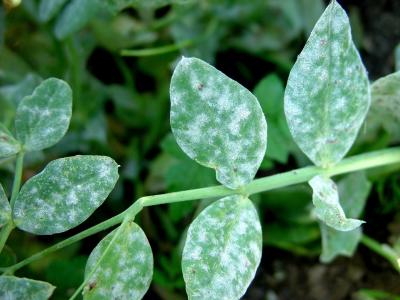
Powdery mildew on peas
(c) A. M. Varela, icipe

Symptoms first develop as a whitish talcum-like powdery growth on upper leaf surface. The powdery growth is composed of fungal spore mass. These areas covered by white powdery growth may enlarge and join up to cover both lower and upper leaf surfaces. Severely affected leaves dry, turn brown and become brittle. Vines can be also attacked. Secondary effects of the disease include sun-burning and premature ripening of fruits.

Powdery mildew affects cucumber, gourd, muskmelon, pumpkin, squash and watermelon. Other hosts include African violets and pawpaws. The powdery mildew fungi are influenced by plant age, humidity and temperature. Foliage is most susceptible 16 to 23 days after unfolding. The fungi reproduce under dry conditions. Infection increases as humidity increases, but does not occur when leaf surface is wet. Optimum temperature for infection is about 27.4degC . However, infection can take place at a temperature as high as 32degC and relative humidity as low as 46%.

What to do:

  • Use resistant varieties, if available.
  • Spray with sulphur based organic fungicides, which provide good control.
  • Destroy weeds belonging to the cucurbit family.

Choanephora fruit rot

Choanephora cucurbitarum

Credits:Biovision-Infonet

Choanephora fruit rot (Choanephora cucurbitarum) on pumpkin
(c) Clemson University – USDA Cooperative Extension Slide Series, www.insectimages.org

C. cucurbitarum mostly attacks tissues that have been damaged by insects or mechanical means. Host tissues have a hairy appearance resulting from the tall fungal filaments that produce a cluster of brown spores (conidia) at their tips.

What to do:

  • Destroy crop residues after harvest.
  • Control cucumber beetles, which are responsible for fungal spread.
  • Spray copper when the disease is observed.
  • Avoid humid conditions during storage.

Nematodes

(Meloidogyne incognita, M. javanica and M. arenaria)

Credits: Biovision-Infonet

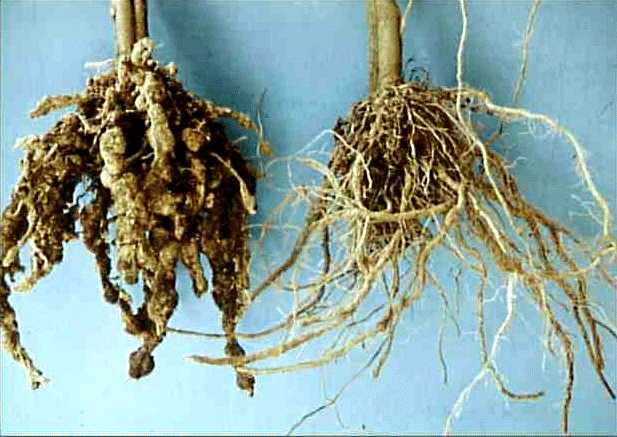
Root-knot nematodes (Meloidogyne incognita / M. javanica) Roots of severely attacked (left) and healthy plant (right). Affected plants are normally stunted and eventually wilt and die. The most characteristic symptom is formation of root galls (knots) and these can be seen with the naked eye. Affected roots rot.
(c) A. M. Varela, icipe

Amongst nematodes infesting passion fruit the root-knot nematodes (Meloidogyne incognita, M. javanica and M. arenaria), are the most serious pests.

Characteristic symptoms of infestation by root-knot nematodes are formation of galls or knots on roots, yellowing of leaves, stunting and eventual wilting of the affected plants.

What to do:

  • Rotate with cassava, cereals, maize, Baby corn, sweet corn, sweet potato, onions, cabbages / kale, garlic or fodder grasses (e.g. Sudan grass).
  • Use of tolerant rootstocks (e.g. P. caerula).
  • Maintain high organic matter (farmyard manure / compost) in the soil.
  • Incorporation of neem into planting at transplanting.

Fusarium wilt

Fusarium oxysporum f.sp. niveum

Credits:Biovision-Infonet

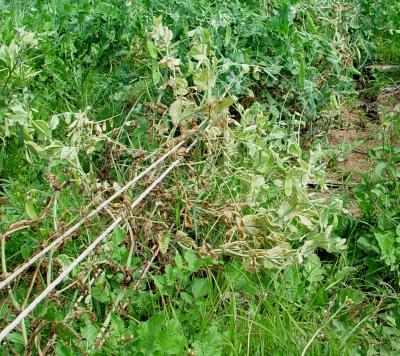
Fusarium wilt on passion fruit. Note browning of water conducting tissues
(c) A.M. Varela, icipe
Fusarium wilt on peas
(c) A.M. Varela, icipe

It causes root rot and corky decay of the stem near ground level, leading to wilting and death. Inside wilted stems the vascular tissue may be discoloured. White to pinkish fungus mycelium may grow over affected tissue. Leaves of affected plants turn yellow and eventually wilt and die. It also causes loss of young plants through damping-off, or of older plants through successive wilting. If fruit has formed, it remains small and loose commercial value.

Cucurbits are attacked at all stages of growth. When seedlings are invaded, they may damp-off and die. Older susceptible plants wilt initially, occasionally recover at night, but usually wilt quickly and die. In wet weather, a white or pinkish fungal growth develops on the surface of dead tissues. In advance stages of the disease, roots may decompose.

What to do:

  • Raising and maintaining the soil pH to 6.0-7.0 by liming helps limit the disease.
  • Practise crop rotation with non-related crops
  • The plant stems need to be kept free of attack from insects whose bites are entry points for fungi and bacteria.
  • The growing of cucurbits on plots where water stagnates, in overly damp or very heavy soil should be avoided, to help keep the plant collar dry.
  • Excessive nitrogen fertilising is to be avoided. Sufficient application of calcium and potassium seems to reduce attacks
  • The destruction of diseased plants and the elimination of plant debris reduce the inoculum in the soil.
  • Deep tillage of the soil is necessary to bury crop residues so that they decompose completely.
  • The nursery soil can be disinfected through solarisation or the application of damp heat (60 degC).
  • Caution is needed to keep from contaminating disinfected plots with agricultural material or contaminated soil.
  • The disinfection of tools (bleach) limits the propagation of the disease.
  • Use of long rotation periods (3 to 4 years).

Gummy stem blight and black rot

Didymella bryoniae

Mycosphaerella citrullina

Phoma cucurbitacearum

Credits:Biovision-Infonet

Black rot on cabbage leaf . Note blackening of veins.
(c) A.A. Seif, icipe
Reddening, followed by black areas of rot, on stems of sugarcane with pineapple disease caused by Ceratocystis paradoxa
(c) Courtesy EcoPort (http://www.ecoport.org): Bureau of Sugar Experiment Stations, Queensland

Circular to irregular spots on leaves. On centres of the spots pycnidia (fungal fruiting bodies) develop. The spots may tear and drop out giving the leaves a tattered appearance. Crown and runners turn pale-brown and then crack oozing a reddish gum. The affected areas are studded with pycnidia. Runners may be girdled and die. Affected fruits exhibit black, leathery, sunken spots and under moist conditions pycnidia develop at the centres. On butternut squash, large irregular areas of the fruit become bronzed with distinct concentric rings. Fruits are spotted and rot. Infected fruits have no commercial value.

What to do:

  • A long rotation (at least 2 years) with non-cucurbit crops.
  • Good sanitation in the field is the best preventive control. Conditions conducive to the pathogen development should be avoided.
  • An accurate monitoring of leaves is necessary to detect early infection and start sprays on time.
  • Avoid building of high humidity in the field.

Anthracnose

Colletotrichum lagenarium

C. orbiculare

Credits:Biovision-Infonet

Anthracnose (Colletotrichum orbiculare) damage to pumpkin leaf (Cucumis sativus).
(c) Clemson University – USDA Cooperative Extension Slide Series, www.insectimages.org

It is a very destructive disease. It causes defoliation and lesions on the fruits. 

The fungus can attack all the above-ground plant parts. Cotyledons (seed leaves) of affected seedlings droop and wilt. Lesions (elongated spots) may form on stems of affected seedlings near the ground. Spots on leaves start as small yellowish areas that enlarge and turn brown. The affected tissue dries, breaks and the whole leaf dies. On vines, the spots are elongated and may kill the vines. Symptoms are most noticeable on fruits. Spots on fruits are circular, black, and sunken. When wet, the centres of the spots become salmon coloured due to a mass of fungal spores. Affected fruits can be destroyed by secondary soft-rot organisms, which enter through broken rind. The fungus is seed-borne. It can survive in crop debris and in weeds belonging to the cucurbit family. Fungal development is promoted by wet conditions, high relative humidity and moderate temperatures (20 to 23.9 degC). Its host range includes cucumber, gherkin, gourd, muskmelon, and watermelon. Cucurbit weeds can also be attacked.

What to do:

  • Use certified disease-free seeds.
  • Treat own seeds in hot water for 20 minutes at 135 degF (43 degC).
  • Plant resistant varieties, if available.
  • Practise crop rotation with non-cucurbits.
  • Destroy volunteer cucurbits and weeds in the field.

Passion Fruit Bugs

(Nezara viridula) , (Boerias maculata) , (Anoplocnemis curvipes) , (Leptoglossus membranaceus)

Credits: Biovision-Infonet

Adult tip wilter (Anoplocnemis curvipes) is 2.5cm long
(c) A.M.Varela, icipe
Stinkbug damage on passionfruit
(c) A.M. Varela, icipe
Green stink bug (Nezara viridula) on passion fruit. Adults are about 1.2 cm long.
(c) A.M. Varela, icipe
Leaf footed bug (Leptoglossus membranaceus) on passion fruit. They have enlarged or flattened extensions on their legs and are about 2cm long.
(c) A.M. Varela, icipe
Bug damage on passion fruit
(c) A.M. Varela, icipe

Several species of sucking bugs feed on passion fruit. The most important are:

The green stinkbug (Nezara viridula)

The brown stinkbug (Boerias maculata)

Coreid bugs such as the giant coreid bug or tip wilter (Anoplocnemis curvipes) and the leaf footed plant bug (Leptoglossus membranaceus).

Bugs suck sap from the growing tips or developing fruits. The bugs pierce the terminal buds, which eventually wilt and die back.

Young plants may be killed if the attack is severe. The punctured young fruits develop localised hardened spots that remain on the fruit reducing their market value.

What to do:

  • In small orchard bugs can be hand picked and destroyed.
  • Watering and irrigation discourage bugs.
  • Old crops or sprouting stumps left in the field provide refuges for bugs so they should be destroyed or dig into the soil.
  • Growing strong smelling plants such as garlic and onion near the crop is reported to reduce infestations.
  • Spraying plants with a soapy solution helps to wash off young bugs.

Leafmining Flies

(Lyriomyza spp)

Credits:Biovision-Infonet

Severe leafminer damage (Lyriomyza spp) on passion fruit
(c) A.M. Varela, icipe
Leafminers damage on passionfruit
(c) A.A. Seif

Feeding and egg laying by leafmining flies cause stippling of leaves. This can kill seedlings and in older plants allows entry of disease-causing microorganisms.

Feeding by maggots causes mining (tunnelling) of leaves reducing the productive leaf area. Heavily attacked leaves may drop off, and may lead to yield losses.

What to do:

  • Control by natural enemies is important.
  • Ploughing can help in exposing pupae to desiccation and natural enemies.
  • Neem products are effective for controlling leafminers.